

Key Takeaways: The Zed Machine at a Glance
- What is it? An industrial-grade food waste dehydrator and digester replacing traditional composting.
- Capacity: Processes up to 1 ton (2000 lbs) of organic waste per cycle.
- Speed: Complete treatment in < 23 hours (Rapid Overnight Cycle).
- Output: Sterile, pathogen-free biomass and distilled water (No methane/CO2e).
- Savings: Reduces waste volume by 90%, slashing hauling costs instantly.
In the modern industrial landscape, businesses are constantly seeking ways to optimize efficiency, reduce costs, and minimize their environmental footprint. For the hospitality, food service, and food processing industries, one challenge looms larger than most: organic waste. Traditionally, the management of food scraps has been a messy, expensive, and environmentally damaging process involving heavy bags, leaky dumpsters, and long-haul truck journeys to overflowing landfills.
However, a technological revolution is underway. The paradigm of "waste disposal" is being replaced by "resource recovery," and leading this charge is a piece of technology designed to change the way the world handles organic matter: the Provectus ZED Machine. This is not just a garbage disposal unit; it is a sophisticated, on-site waste processing plant that transforms a liability into a sterile, verifiable asset in less than a day.
To appreciate the solution, one must first understand the depth of the problem. Support structures for food waste management have historically been reactive and linear. Kitchen staff throw scraps into a bin; porters haul those bags to a loading dock; a waste management company sends a diesel-guzzling truck to pick it up; and finally, the waste is dumped in a landfill.
This traditional model is an environmental disaster. Food waste is approximately 70-80% water. When we transport raw food waste, we are effectively burning fossil fuels to truck water around the country. Once in the landfill, that organic matter decomposes anaerobically, releasing methane—a greenhouse gas with a warming potential significantly higher than carbon dioxide.
On an operational level, raw food waste is a nightmare. It rots immediately, creating foul odors that can tarnish a business's reputation. It attracts vermin (rats, flies), posing severe health and safety risks. It necessitates refrigerated storage rooms to keep the smell at bay, consuming expensive energy. And financially, businesses are pay-per-lift or by weight, meaning they are paying premium rates to dispose of heavy water weight.
The Provectus ZED Machine is an industrial-grade food waste dehydrator and digester. Unlike traditional composters that rely on biological processes (bacteria, enzymes, and time) or macerators that simply chop waste and flush it into the sewage system, the Zed Machine utilizes a proprietary thermal-mechanical process to physically transform the material.
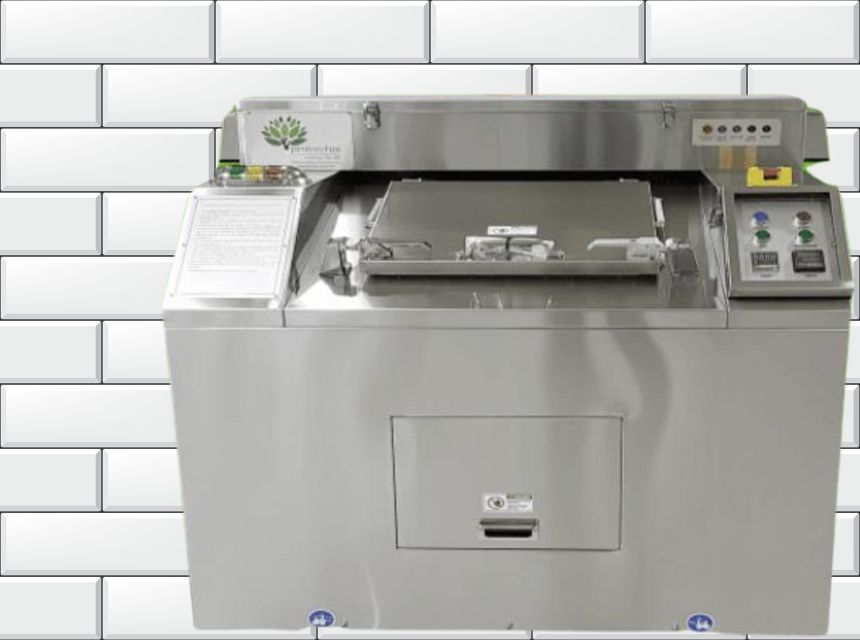
How does one turn a ton of wet, rotting food into a sterile, dry powder in under a day? The Zed Machine utilizes a multi-stage process that combines controlled heat, continuous agitation, and airflow.
The primary mechanism is dehydration. Since food waste is predominantly water, the machine heats the material to evaporate this moisture. By removing the water content, the Zed Machine achieves a massive reduction in volume and weight—typically reducing the original mass by up to 90%. A ton of wet waste enters, and roughly 200-300 lbs of dry material exits.
Crucially, the process involves high temperatures that exceed the survival threshold for pathogens. This "kill step" ensures that the output is free from harmful bacteria such as Salmonella, E. coli, and Listeria. Unlike traditional composting, which requires careful temperature monitoring over weeks to ensure pathogen die-off, the Zed Machine guarantees sterilization in every cycle. This makes the output safe to handle and store without fear of biohazards.
The machine produces two distinct, valuable outputs:
Deploying a Zed Machine shifts waste management from an external service to an internal process, granting the business total control.
By processing waste immediately on-site, the "rot window" is closed. There are no bags of leaking garbage sitting on the loading dock for days awaiting pickup. This effectively eliminates the source of odors and the food source for pests (rats, cockroaches, flies). The workspace becomes cleaner, safer, and more compliant with health department standards.
For a facility generating a ton of waste a day, the logistical burden of storage and haulage is immense. The Zed Machine reduces that physical burden by 90%. Instead of managing 20 full bins of wet slop, the team manages 2 bins of dry, odorless powder. This frees up valuable floor space previously dedicated to waste storage and reduces the labor hours spent moving trash.
While this article does not discuss specific pricing, the economic model of the Zed Machine is built on cost avoidance.
For modern corporations, sustainability is not just about "doing good"; it is about quantifiable metrics. The Zed Machine provides concrete data for Environmental, Social, and Governance (ESG) reporting.
Since organic matter is sterilized and dried rather than left to rot, the methanogenesis process is completely halted. Use of the Zed Machine ensures that the food waste generated by the facility will never release methane in a landfill.
The logistics of waste management are carbon-intensive. By reducing the weight and volume of waste by 90%, the number of waste collection trucks required is reduced proportionally.
Many organizations have committed to "NetZero" or "Zero Waste to Landfill" targets. The Zed Machine is a cornerstone technology for achieving these goals.
The Zed Machine is an industrial workhorse designed for high-volume generators of organic waste.
The era of "out of sight, out of mind" waste management is ending. The Provectus Zed Machine represents the future of this management.